Are you struggling with low FPS, frustrating lag, or stuttering performance on your gaming laptop? This comprehensive guide provides actionable strategies to supercharge your portable rig. Discover essential tips and tricks for system optimization, driver updates, and in-game settings adjustments to unlock peak performance. Learn how to tackle common issues like ping spikes and frame drops, ensuring a smoother and more immersive gaming experience across all your favorite titles, from fast-paced FPS games to sprawling RPGs and competitive Battle Royales. We'll dive deep into managing background processes, configuring power plans, and understanding hardware limitations to help you get the most out of your machine in 2026. This is your ultimate resource for turning a struggling laptop into a lean, mean, gaming machine, giving you the edge you need for any challenge.
how to optimize laptop for gaming FAQ 2026 - 50+ Most Asked Questions Answered (Tips, Trick, Guide, How to, Bugs, Builds, Endgame)
Welcome to the ultimate living FAQ for optimizing your gaming laptop in 2026! As games become more demanding and hardware evolves, staying on top of performance tweaks is crucial. This comprehensive guide, updated for the latest software and hardware advancements, aims to answer all your burning questions about maximizing your laptop's gaming potential. Whether you're a beginner struggling with stuttering or an advanced user looking for that extra edge, we've got you covered with tips, tricks, and solutions to common issues. Get ready to transform your portable rig into a high-performance machine ready for any challenge the gaming world throws at you in 2026.
Performance Basics & Setup
How do I improve FPS on my gaming laptop?
To boost FPS, first update your graphics drivers from NVIDIA or AMD. Next, switch your Windows power plan to 'High Performance' when plugged in. Close all unnecessary background applications, especially web browsers and chat apps, to free up CPU and RAM resources. Finally, adjust in-game graphics settings, prioritizing reductions in shadows, anti-aliasing, and volumetric effects. These steps provide significant immediate gains.
What are the best settings for gaming on a laptop?
The best settings balance visual quality with smooth performance. Start by setting your display to its native resolution and refresh rate. Prioritize lower settings for computationally intensive features like 'Shadow Quality,' 'Anti-Aliasing,' and 'Volumetric Clouds.' Keep 'Texture Quality' as high as your VRAM allows. Enable AI upscaling technologies like DLSS or FSR if supported for optimal results. This combination ensures a visually appealing experience without sacrificing frames.
Why is my gaming laptop lagging and how can I fix it?
Laptop lag often stems from insufficient resources or thermal throttling. Fix it by ensuring updated drivers, using 'High Performance' power mode, and closing background apps. Check your laptop's cooling; dust buildup or poor airflow can cause components to overheat and slow down. For online lag, switch to an Ethernet connection, as Wi-Fi instability is a common culprit for high ping. Regular system maintenance helps.
Is a cooling pad necessary for gaming laptops?
Myth vs Reality: Many believe cooling pads are a magical fix. While not strictly
Ever wondered why your brand-new gaming laptop sometimes feels sluggish, even with the latest titles? It's a question many gamers ask, and you're definitely not alone in seeking that smooth, high-frame-rate experience everyone talks about. Achieving peak performance on a portable machine often feels like a dark art, but I'm here to tell you it's totally manageable with the right approach. We're going to dive deep into how you can transform your gaming laptop into a true powerhouse, ensuring you get the best possible FPS, minimize lag, and completely eliminate those annoying stutters that ruin your immersion. We'll cover everything from simple tweaks to more advanced strategies, all tailored for what's relevant in 2026. Get ready to unlock your laptop's full gaming potential!
Beginner / Core Concepts
1. Q: What's the absolute first thing I should do to improve my laptop's gaming performance?A: Hey there! I get why this confuses so many people, with so much info out there. The very first, and honestly most impactful, step you should take is always to update your graphics drivers. It’s like giving your graphics card a brand-new instruction manual, finely tuned for the latest games and performance boosts. NVIDIA and AMD are constantly releasing driver updates that significantly enhance game compatibility and optimize performance, sometimes by a surprising margin. Overlooking this step is like leaving free performance on the table, and who wants to do that? Just head over to your GPU manufacturer’s website, grab the latest stable release for your specific model, and install it. Trust me, it’s foundational. You’ve got this!2. Q: How important are Windows power settings for gaming, and which one should I use?A: This one used to trip me up too, but it’s super important, friend. Windows power settings are crucial because they dictate how much juice your laptop’s CPU and GPU can draw. If you’re on a 'Balanced' or 'Power Saver' plan, your system is literally holding back its full potential to conserve battery, which is terrible for gaming. Always switch to the 'High Performance' or 'Ultimate Performance' power plan when you're plugged in and gaming. These plans tell your laptop to unleash all its processing power, ensuring your components run at their maximum clock speeds. It’s a quick, free change that can deliver noticeable frame rate improvements. Don't forget to revert if you need battery life later!3. Q: Should I close all background applications before starting a game?A: Absolutely, yes, you totally should! Think of your laptop’s resources—CPU cycles, RAM, GPU memory—as a limited pie. Every background application, even small ones like Discord, web browsers, or chat apps, takes a slice of that pie. For gaming, you want as big a slice as possible reserved for the game itself. Closing unnecessary apps frees up those precious resources, which can directly translate into higher FPS, reduced lag, and a smoother overall experience. It's especially critical for games that demand a lot of memory or processor power. A quick check of your Task Manager before launching a game can reveal hidden resource hogs. It's a simple habit that pays big dividends.4. Q: What's the deal with laptop cooling and how does it affect gaming performance?A: Oh, cooling is a *huge* deal, a real cornerstone of sustained gaming performance. Laptops are compact, meaning heat can build up quickly, and when components get too hot, they ‘throttle’ or intentionally slow down to prevent damage. This thermal throttling is a primary culprit behind FPS drops and stuttering during longer gaming sessions. Good cooling prevents this slowdown. Ensure your laptop’s vents are clear, use a cooling pad if possible, and consider regular dust cleaning. Efficient cooling allows your CPU and GPU to maintain their boost clocks, giving you consistent high frames. It’s an ongoing battle, but a winnable one for sure!Intermediate / Practical & Production
5. Q: How do in-game graphics settings impact performance, and what should I prioritize?A: You're asking a fantastic question that gets to the heart of game optimization. In-game graphics settings have an enormous impact on performance because they directly control how much work your GPU and CPU need to do. When it comes to prioritizing, generally focus on reducing settings that significantly increase render load. Things like 'Shadow Quality,' 'Volumetric Clouds,' 'Anti-Aliasing' (especially MSAA), and 'Draw Distance' are usually big FPS killers. Start by lowering these first. 'Texture Quality' often has less impact if you have enough VRAM. Aim for a balance where the game looks good but runs smoothly. Experimentation is key; a few frames here and there can make all the difference in competitive play, giving you a competitive edge. Try tuning these on the fly, and you'll quickly see which ones matter most for your specific setup.6. Q: Is overclocking a gaming laptop a good idea for more FPS?A: This is a spicy topic, and I totally get the appeal of pushing hardware to its limits. Overclocking a gaming laptop, while technically possible, comes with significant caveats compared to a desktop PC. Laptops have much tighter thermal envelopes, meaning they struggle to dissipate the extra heat generated by overclocking. While you might gain a few frames initially, you risk instability, accelerated component degradation, and severe thermal throttling that could actually reduce performance over time. Most modern gaming laptops already come with factory-tuned boost clocks that are near their thermal limits. For most users, I'd honestly advise against it; the risks usually outweigh the marginal gains. Focus on efficient cooling and software optimization instead. You want your laptop to last, right?7. Q: What role do display refresh rates play in optimizing the gaming experience?A: Oh, refresh rates are absolutely huge for a truly smooth and responsive gaming experience, a concept often overlooked by beginners. Your laptop's display refresh rate (e.g., 60Hz, 120Hz, 144Hz, 240Hz) determines how many times per second the screen can update the image. If your game is running at 100 FPS on a 60Hz display, you're only seeing 60 of those frames; the rest are essentially wasted, leading to screen tearing or input lag. Higher refresh rates, especially when paired with technologies like G-Sync or FreeSync, allow you to see more frames per second, resulting in incredibly fluid motion and reduced input latency. It makes a tangible difference, particularly in fast-paced games like FPS or MOBA titles. If your laptop has a high refresh rate panel, ensure it's enabled in Windows display settings! It’s a game-changer you won't want to miss.8. Q: How can I ensure my network connection isn't causing lag or high ping?A: Ah, network issues, the bane of many online gamers! This is super important because even with a powerhouse laptop, a bad connection will kill your experience. First, always try to use a wired Ethernet connection instead of Wi-Fi when gaming. Ethernet provides a more stable, lower-latency connection, drastically reducing ping spikes. If Wi-Fi is your only option, ensure you’re on a 5GHz band for less interference and closer to your router. Also, check for bandwidth hogs on your network; someone streaming 4K video can dramatically impact your ping. Consider Quality of Service (QoS) settings on your router to prioritize your gaming traffic. In 2026, low-latency Wi-Fi 7 is becoming more common, offering significant improvements, but Ethernet remains king for stability. It’s all about minimizing those digital delays, right?9. Q: Are game-specific optimization tools or launchers worth using?A: That's a great question, and it really depends on the tool, but generally, yes, many of them are quite useful. Most game launchers (like Steam, Epic Games, GOG) offer some basic settings, but I'm talking about tools like GeForce Experience or AMD Adrenalin Software. These often provide optimized settings recommendations tailored to your specific hardware and can simplify driver updates. They can also offer in-game overlays for monitoring FPS and temperatures. Some third-party tools promise magical boosts, but always be cautious; stick to reputable software. The goal is convenience and intelligent optimization without adding bloat. For specific titles, community guides often highlight optimal settings that these tools might not perfectly capture. Use them wisely, and they can definitely enhance your experience.10. Q: What about optimizing storage? Does an SSD make a difference for gaming?A: Oh my goodness, an SSD makes a monumental difference! If you're still running games from a traditional Hard Disk Drive (HDD), upgrading to a Solid State Drive (SSD) is one of the most impactful upgrades you can make. It won't directly boost your FPS, but it will drastically reduce game load times, texture pop-in, and overall system responsiveness. Imagine booting into Windows or loading into your favorite open-world RPG in mere seconds instead of minutes. Modern games, especially those from 2026, are designed with SSDs in mind, relying on fast asset streaming. If your laptop only has an HDD, installing an NVMe SSD is a game-changer for speed and smoothness. It’s a quality-of-life upgrade that profoundly affects your gaming workflow. You won't regret it!Advanced / Research & Frontier 2026
11. Q: How do I manage VRAM usage effectively, especially in demanding 2026 titles?A: Managing VRAM (Video Random Access Memory) is becoming increasingly critical, especially as 2026 titles push visual fidelity limits. It’s like the dedicated workspace for your GPU. Over-utilizing VRAM leads to stuttering as the system has to offload data to slower system RAM or even the page file. The key is to monitor VRAM usage (often visible in game settings or with monitoring tools like MSI Afterburner) and adjust graphics settings accordingly. 'Texture Quality' is the biggest VRAM hog, so prioritize lowering that first if you're hitting limits. Other culprits include high-resolution shadow maps and complex anti-aliasing methods. Some advanced GPUs in 2026 feature intelligent VRAM management and upscaling tech, but manual tuning remains essential for optimal performance on laptops with finite VRAM. Keep an eye on those VRAM meters!12. Q: What are the latest developments in AI upscaling technologies like DLSS and FSR for laptops?A: This is where the future of laptop gaming really shines, honestly! AI upscaling technologies like NVIDIA's DLSS (Deep Learning Super Sampling) and AMD's FSR (FidelityFX Super Resolution), along with Intel's XeSS, have become indispensable for maintaining high frame rates on modern hardware, especially laptops. These technologies render games at a lower internal resolution and then use advanced AI algorithms or sophisticated spatial upscaling to reconstruct the image to your display's native resolution, often with stunning quality. In 2026, these techniques are incredibly mature, offering near-native image quality with significant FPS boosts, sometimes 50% or more. They effectively give your GPU extra headroom, making high-end visuals playable on less powerful laptop GPUs. Always enable them if your game and GPU support it; it's practically free performance. It’s a technological marvel, seriously.13. Q: How can I fine-tune CPU affinity and priority for specific games?A: Alright, this is a more advanced tweak, but for certain scenarios, it can really help. CPU affinity lets you dedicate specific CPU cores to a game, while priority determines how much CPU time a process gets. Sometimes, Windows scheduler might not optimally assign cores, or background tasks might interfere. You can manually adjust this via Task Manager (Details tab, right-click the game executable). For example, setting a game's priority to 'High' (be cautious with 'Realtime') or disabling core 0 for a game (as some older games struggle with Hyper-Threading) can sometimes iron out micro-stutters or improve stability. However, modern operating systems and games are usually pretty good at this automatically. Only tinker here if you're experiencing specific issues and understand the potential implications. It's a precise scalpel, not a blunt instrument.14. Q: What's the impact of Resizable BAR (ReBAR) or Smart Access Memory (SAM) on laptop gaming in 2026?A: Ah, ReBAR and SAM, these are fantastic under-the-hood optimizations that you really want to leverage if your laptop supports them in 2026. These technologies, pioneered by AMD (Smart Access Memory) and now widely adopted as an industry standard (Resizable BAR), allow your CPU to directly access your GPU’s entire VRAM buffer, rather than being limited to small 256MB chunks. This direct, full-size access drastically improves data transfer efficiency between the CPU and GPU. The result? Measurable FPS improvements in many games, often in the range of 5-15%, especially at higher resolutions. It's a 'set it and forget it' feature usually enabled in your laptop's BIOS/UEFI, assuming your CPU, GPU, and motherboard chipset are compatible. It's another piece of that crucial synergy between components. You'll want to check if it's active!15. Q: Are there any upcoming 2026 technologies that will further change laptop gaming optimization?A: You're looking ahead, I love that! In 2026, we're seeing continued advancements that will redefine laptop gaming optimization. Expect even more sophisticated AI-driven power management systems that dynamically adapt to game loads, going beyond current power plans. Real-time, per-game cloud-based optimization profiles are also gaining traction, where server-side AI analyzes millions of gameplay hours to suggest optimal settings for your exact hardware. Furthermore, we'll see deeper integration of system-level optimizations that can predict performance bottlenecks before they occur, using advanced machine learning reasoning models. New generations of hybrid CPUs, integrating even more efficient power-saving cores with performance cores, will also change how we think about background processes and resource allocation. And of course, the next iterations of DLSS, FSR, and XeSS will continue to push visual quality and performance envelopes, making previously impossible settings a reality on portable machines. The future is looking incredibly optimized!Quick 2026 Human-Friendly Cheat-Sheet for This Topic
- Keep your graphics drivers updated always, it's free FPS.
- Plug in your laptop and switch to 'High Performance' power mode for maximum power.
- Close background apps to free up precious CPU and RAM for your game.
- Ensure good cooling; a hot laptop is a slow laptop.
- Tweak in-game settings: lower shadows and anti-aliasing first for big gains.
- Use an Ethernet cable for stable online gaming, ditch Wi-Fi if you can.
- Enable DLSS/FSR if available; it's a huge, almost magical FPS boost.
Maximize laptop FPS, Fix gaming lag, Reduce stuttering, Update graphics drivers, Optimize Windows settings, Manage background apps, Improve cooling, Adjust in-game graphics, Configure power plans, Upgrade components 2026.
35


How To Optimize Gaming Laptop Performance In 2026 How To Optimize Gaming Laptop Performance . 5 Tips To Optimize Your Gaming Laptop 5 Tips To Optimize Your Gaming Laptop . How To Optimize ANY LAPTOP For Gaming BOOST FPS INCREASE PERFORMANCE . Ultimate Guide To Boost Your Laptop For Gaming Top Performance . How To Optimize Your Gaming Laptop For Better FPS And Performance How To Optimize Your Gaming Laptop For Better FPS And Performance Smart Electronics 1536x860

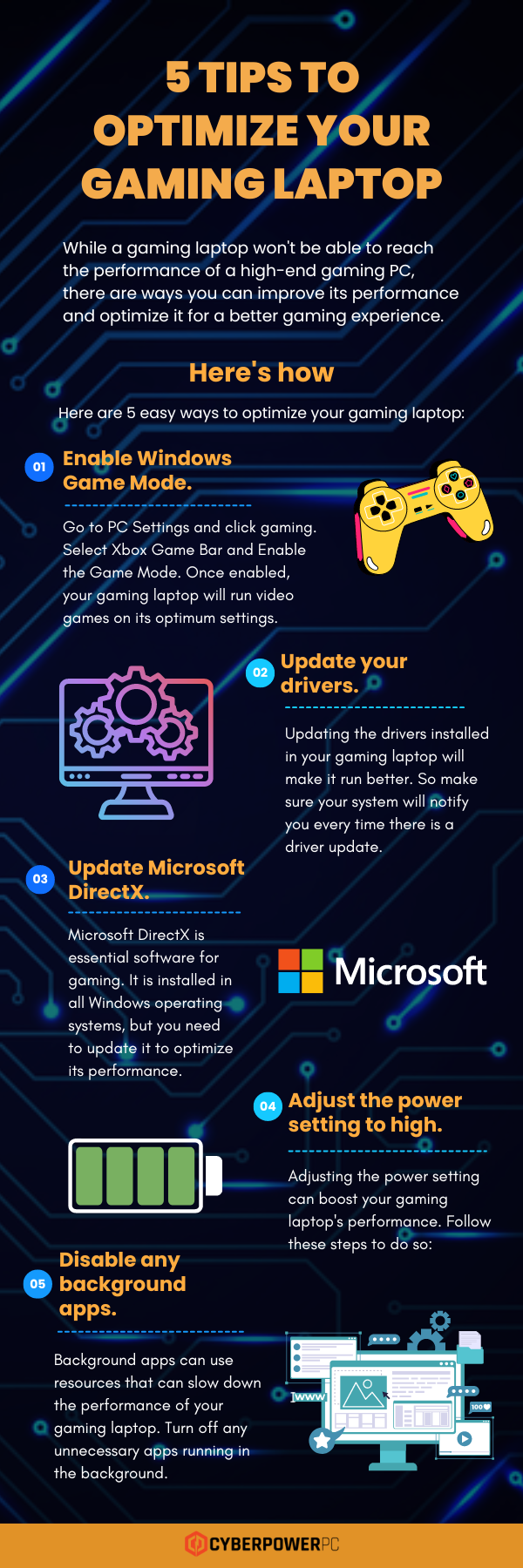
How To Optimize Your PC Laptop For Maximum Gaming Performance Kill . How To Optimize Old Laptop For Gaming 5 Tips To Optimize Your Gaming Laptop 1 . How To Optimize Your Laptop For Maximum Performance Blog 02 . How To Optimize A Gaming Laptop For 144Hz Gaming Trotons Tech Optimize Gaming Laptop For 144Hz Gaming.webp. How To Optimize Your Gaming Laptop For 144Hz Smooth Gameplay How To Optimize Your Gaming Laptop For 144Hz



Optimize Your Gaming Experience The Ultimate PC Guide . How To OPTIMIZE Laptop FOR GAMING FIVEM GTA V DOTA 2 ROBLOX Hqdefault . Optimize Your Gaming PC For Best Performance And FPS Boost YouTube . Lenovo To Release An Ultrawide Legion Pro Gaming Laptop With Rollable Lenovo Legion Go Pro Rollable . How To Optimize Old Laptop For Gaming V4 460px Upgrade A Laptop For Gaming Step 14


How To Optimize Windows 11 For Gaming Hone Blog Hone.gg Preview Image . How To Optimize Gaming Laptop For 4k Full Guide In 2025 How To Optimize Gaming Laptop For 4k 2 1024x683 . How To Optimize ANY Laptop For Gaming Performance Boost FPS Fix . The Best Cheap Gaming Laptops For 2026 Tested For Gaming Top 3 Gaming Laptops Of 2026 - The Ultimate Guide 1200x342 . HOW TO OPTIMIZE PC FOR GAMING BEST PERFORMANCE 2024 LAPTOP PC YouTube




3 Ways To Optimize Your PC Performance WikiHow Aid2406091 V4 728px Optimize Your PC Performance Step 3 Version 4 . ASUS Republic Of Gamers Gi I Thi U D I S N Ph M Laptop Gaming T Ph . How To Optimize ANY Laptop For Gaming Windows Performance Boost FPS . 3 Ways To Optimize Your PC Performance WikiHow Aid2406091 V4 728px Optimize Your PC Performance Step 19 . Red Magic Gaming Laptop 16 PRO 2026 Red Magic Gaming Laptop 16 PRO 2026 74474549hdx


How To Optimize Low End Laptops PC For GAMING Performance In 2021 . How To Optimize Your Gaming PC For Ray Tracing 2026 Guide How To Optimize Your Gaming PC For Ray. How To Optimize Windows 10 For Gaming And Performance Fix Lag . Check Out The Latest ROG Gaming Gear Revealed At CES 2026 . Top 10 Most Anticipated Games Of 2026 What To Watch Out For GAMES IN 2026



How To Optimize Your PC For Gaming High Performance In 2 Minutes . How To Optimize Your PC For Roblox Fix Lag Boost FPS Smoother . 3 Ways To Optimize Your PC Performance WikiHow Aid2406091 V4 728px Optimize Your PC Performance Step 4 Version 4 . How To Reduce Lag And Boost FPS In Roblox On Windows Best Gaming Laptops Featured . How To Optimize ANY Laptop For Gaming Performance Boost FPS Fix